The Sign That Never Was
Jun 1




I love a good slogan. Who doesn’t?
Slogans are fun to say, and they look good on a sign, which are two of the best qualities that a combination of words can have!
The best slogans transcend time and even context. For example, “Don’t Mess with Texas” was created for the Texas Department of Transportation in 1986 as part of an anti-littering campaign. The intention behind the slogan has nothing to do with bragging about how tough Texans are and everything to do with begging drivers to stop throwing garbage from their car windows.
Our region has enjoyed several catchy slogans over the years. Perhaps you remember, “Duluth, the air-conditioned city.” Or maybe you are familiar with the more contemporary “Talk Duluthy To Me” campaign?
The Iron Range has a couple of great slogans of their own.
Hibbing, “We’re Ore And More”
Chisholm, “The Heart of the Iron Range”
Mountain Iron, “Taconite Capital of the World”
And who could forget-Virginia, “Home of Minnesota’s Tallest Bridge”
I didn’t know Virginia had Minnesota’s tallest bridge, but thanks to that great slogan, we all learned something today. But now I’d like to travel back in time, to the first decade of the last century, to explore the world of local slogans.
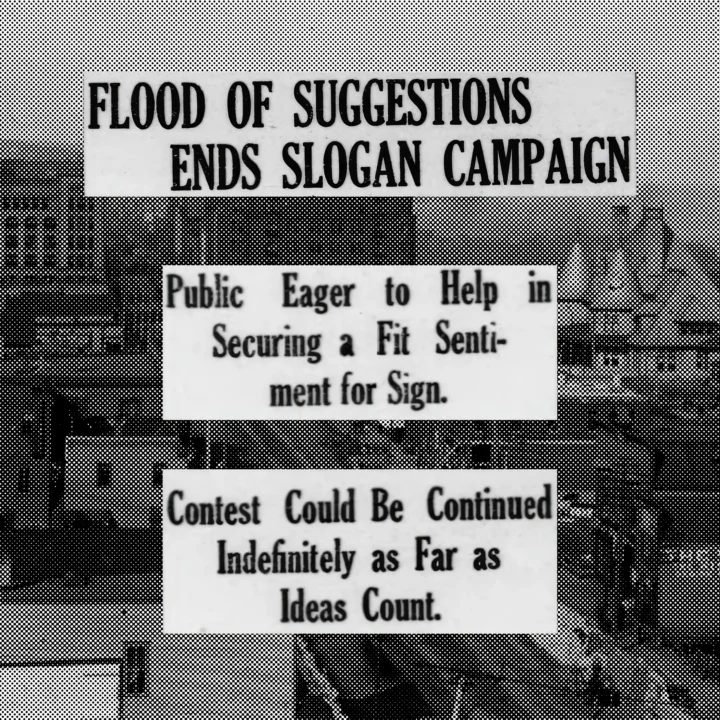
In 1911, it was proposed by W. N. Ryerson, chairman of the Duluth Commercial Club’s publicity committee, that the city should have a gigantic sign to advertise Duluth. It wasn’t meant to advertise any individual business or industry, just the city itself. It was to spread what we might today call “brand awareness.”
This fully illuminated sign would be no less than eight feet in height and would be propped on the hillside so that visitors could read a phrase that would “most accurately express Duluth.” [1] Or at least, that’s what Mr. Ryerson proposed.
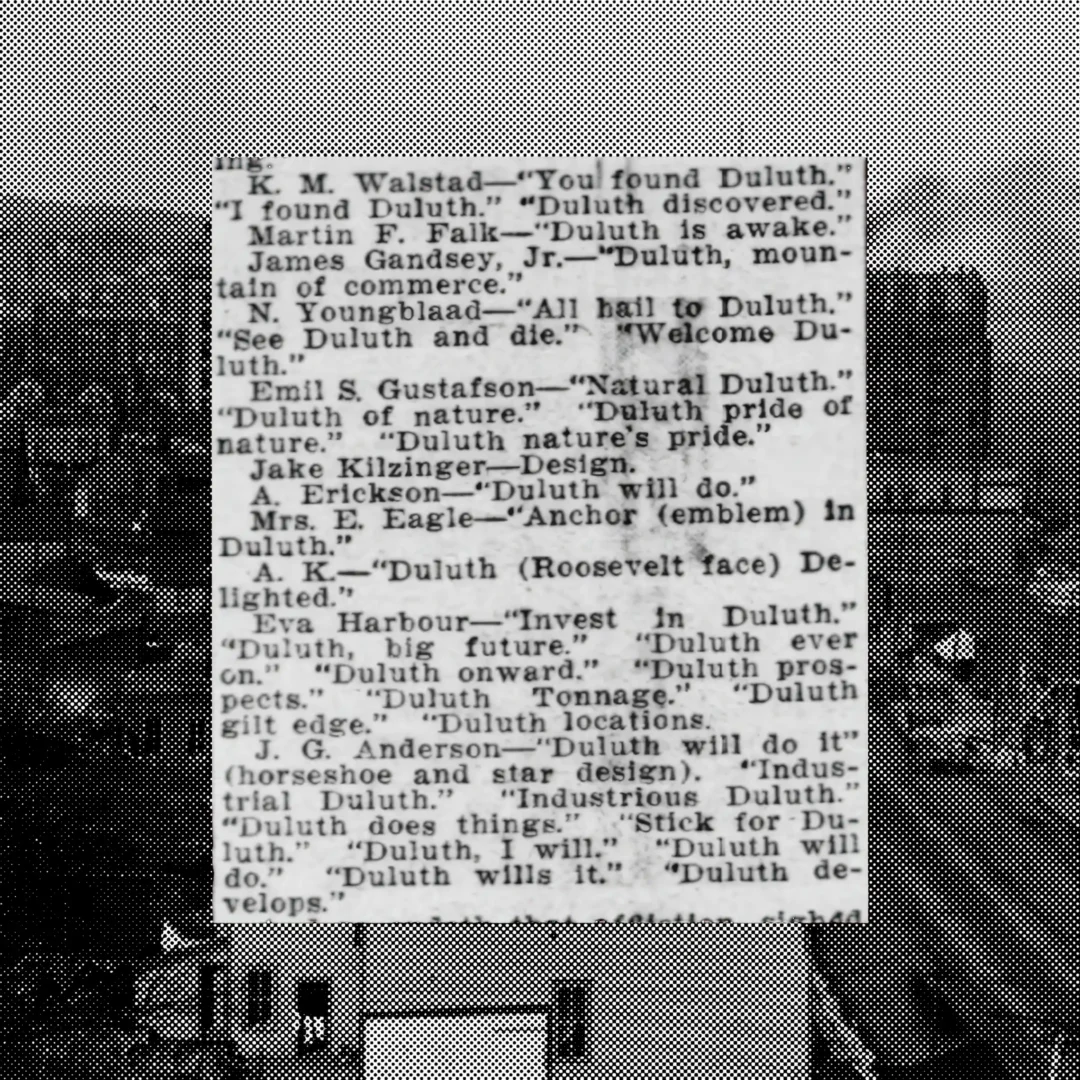
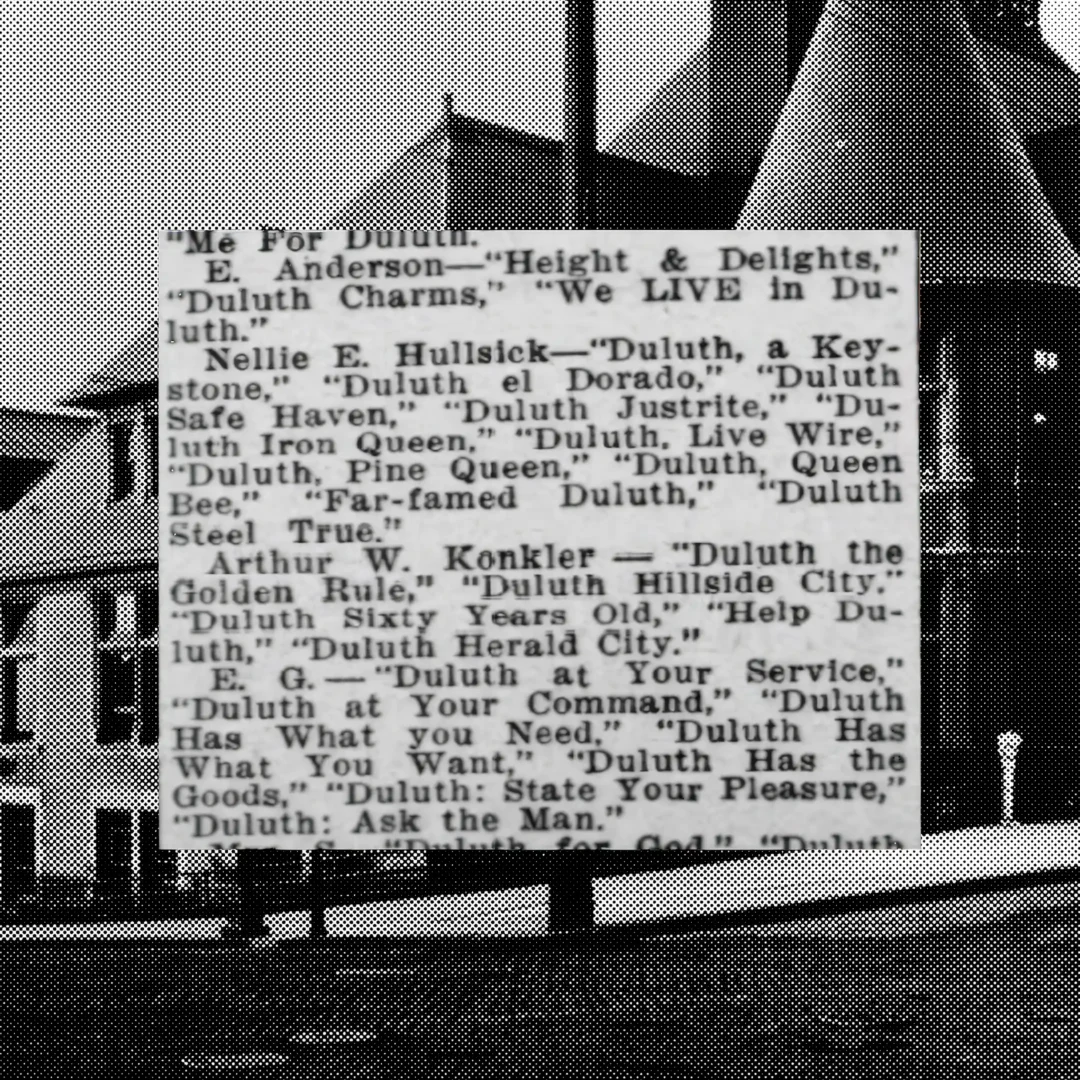
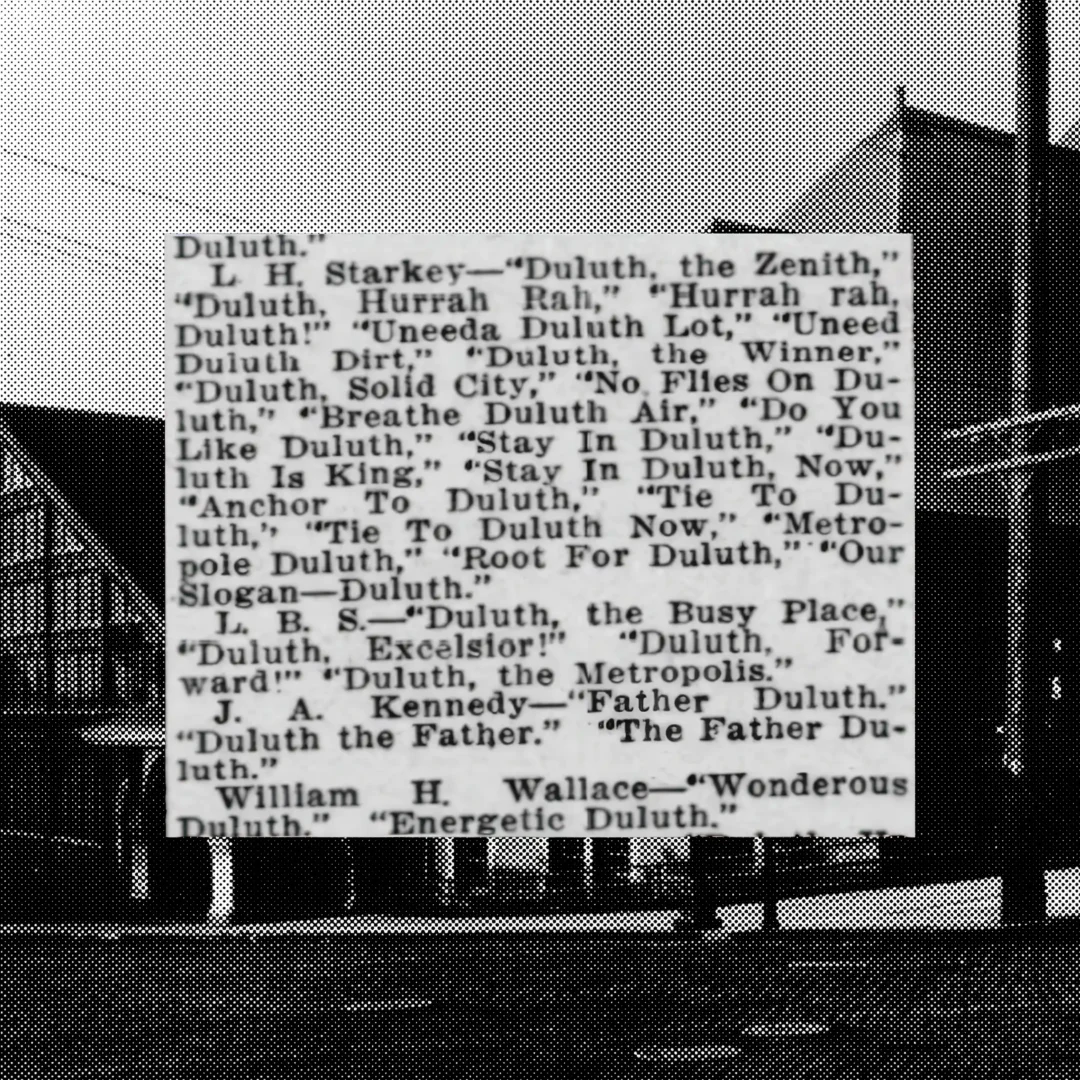
To determine what that glowing phrase might be, The Duluth Herald decided to hold a contest. They offered a $10 prize to whoever could submit the best slogan that was not longer than 15 letters in length and contained the word “Duluth.” After this announcement, hundreds of people wrote in to The Duluth Herald with their suggestions. The paper shared select slogans accompanied by the names of those who submitted suggestions, and interest in the project continued to grow.
The proposed sign also grew.
The Duluth Herald. February 1, 1911
“It was originally stated that the letters probably would be eight feet in height, but it seems that this was merely a tentative suggestion as a minimum. The opinion now is that the sign may be much larger than that- perhaps thirty feet in height.”
Great! Now it might be much larger, according to “the opinion.” The opinion of whom? Let’s not get bogged down in all the details. This sign is happening, and it’s going to be great.
Later in February, the Duluth Herald wrote that there was to be a meeting of the Commercial Club’s publicity committee on the 16th of that month. The article goes on to say that “it is probable that at this meeting some scheme will be evolved for deciding to whom shall be awarded the $10 prize.” [2]
They go on to say that The Herald held the contest, and that the Commercial Club was under no obligation to use the winning slogan, whatever it may be. Unfortunately, the next day, it was reported that at the meeting, the committee did not discuss the slogan contest.
Oh well!
On March 3rd, The Duluth Herald finally announced the winner of the prize for best slogan. That crisp $10 bill was to be awarded to Mrs. G. S. Hannel, of 412 East Fifth Street for her slogan, “Watch Duluth Grow.” The Herald conceded that the slogan was not entirely unique, but it was particularly appropriate for Duluth.
The Duluth Herald. March 3rd, 1911
“…The city (Duluth) is believed to be entering an unprecedented period of growth that will bring it to the position of the ‘Pittsburgh of the West’ within a very few years.”
The Herald goes on to say that it was their own editorial staff that held a vote and selected their winner. The article also very clearly states that in no way was the publicity committee bound to use the winning slogan, or any of the submitted slogans. Regardless, The Herald passed on all 2,000-ish submitted slogans to the Commercial Club. Now it was only a matter of time until an official slogan was selected, and then the sign would be erected.
Spring marched along without any update, and then summer came and went without so much as a peep. The remainder of 1911 passed, and there was still no word. The silence would continue throughout 1912.
Then on January 31st, 1913, the Duluth Herald featured a small article entitled:
“What Other Cities Are Doing – Activities of Other Municipalities, Which Might or Might Not Be Copied in Duluth.”
The piece informed readers that a giant sign with words made of electric lights would be installed in Marshalltown, Iowa. It was reported that a slogan such as “Marshalltown For Me,” or “Welcome to Marshalltown,” would be used on the sign. The author goes on to say that two years ago Duluth discussed having an electric sign of its own, which would have been “an excellent advertisement for the city.” [3]
Alas, Duluth never had its giant, lit, hillside sign. Marshall would install theirs, with the name of the town on one side and the phrase, “come again” on the other. [4]
That’s right, this is a blog post about a proposed sign that never came to be.
This is the reality of history research. Oftentimes, I’ll come across a thread that sounds interesting and will begin to pull. I can spend many hours putting together the details of a story that ends up as a big ‘ol nothing. It’s far more likely for things to disappear without a tidy or satisfying conclusion.
I like to imagine the Duluth that might have been, had it only had the courage to put up a big, glowing sign. Would things have been different for us? Would we truly have become the “Pittsburgh of the West?”
Look at some of the slogans submitted for the naming contest. Perhaps you’ll find the phrase that would have ushered in a grander narrative for the city. I’m suspicious that “Duluth: State Your Pleasure” would have been a real gamechanger.
[1] The Duluth Herald – January 28th, 1911
[2] The Duluth Herald – February 15th, 1911
[3] The Duluth Herald – January 31st, 1913
[4] Evening Times-Republican – August 8th, 1913